
Field note · Nila Original
Your ring doesn't know how last night felt
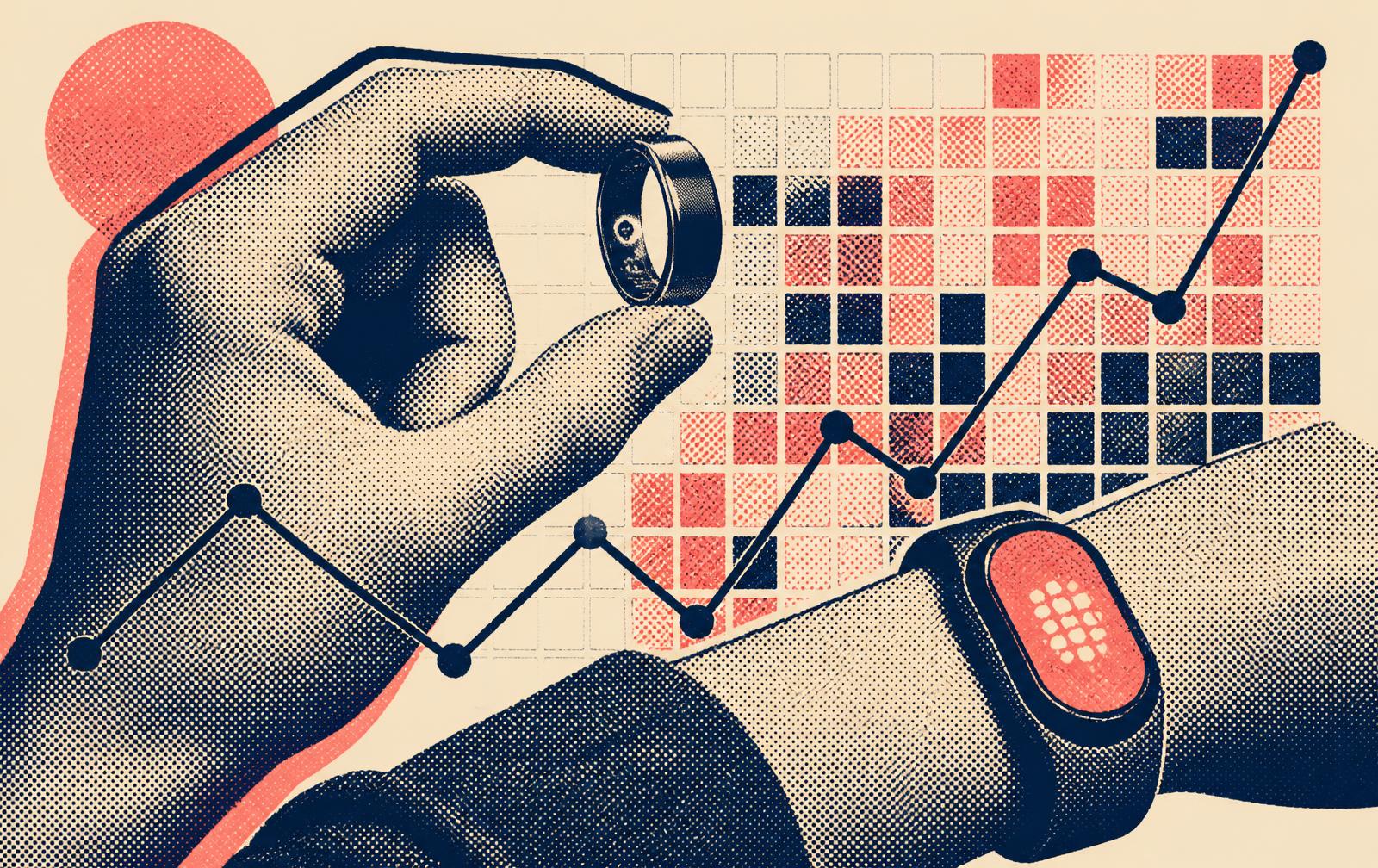
Wearables are everywhere in midlife health now. Here's what the validation research says about sleep tracking, where midlife sits in that evidence, the rules we set before bringing Apple Health and Health Connect data into Nila, and how those rules are built into the product itself.
Nila now reads from Apple Health and Health Connect. When you turn it on, the numbers your phone, watch or ring already collect show up beside the things you log yourself: how you slept, how the day went, what your body did.
Our data standards piece covers what you tell Nila about yourself. This one covers what your devices tell it, and building that took a decision we made early and want to say out loud, because wearables are everywhere in midlife health now, and the research on what these devices can and can't actually tell you deserves a plain-language airing.
What is a device measuring, and what is it inferring?
That question applies to every device on every wrist and finger, including the data we now bring into Nila. And there's good, peer-reviewed research that answers it, which is more useful than any one company's news cycle.
A ring or a watch measures movement, and it measures signals like heart rate and skin temperature. It doesn't measure brain activity. Sleep staging, the split into light, deep and REM, is a model built on top of those signals. So is a readiness score. So is a recovery score. Those are interpretations, and they're only as good as the model behind them.
What the validation research actually shows
There's a real and growing literature here, and it's more nuanced than either the marketing or the backlash.
A 2025 study in Scientific Reports put three commercial ring trackers against polysomnography in a university sleep lab with a population that had a mix of sleep disorders. Most earlier validation work had been done in healthy people, which is exactly the group where devices look best. The pattern that shows up across this literature is consistent: agreement is strongest for the crude question of asleep versus awake, weaker for how long you were awake in the night, and weakest for stage-by-stage classification. Performance also degrades in the people who most want an answer, meaning those with a sleep disorder.
A 2024 evaluation of three commercial wearables in healthy adults in Sensors found the same shape of result, and a 2024 report in Frontiers in Sleep on a research-grade study watch reinforced it. This isn't a scandal. It's what sensor science looks like when it's being done properly, and it's why the honest framing of a nightly sleep number is "an estimate from a model", not "your sleep".
Where midlife sits in all of this
Here's the part that matters most to us.
Menopause research has been trying to instrument hot flashes for decades. The MsFLASH network compared sternal skin conductance monitors against what women reported, in the lab and in daily life. In the lab, the monitors did reasonably. Out in real life, agreement between what the monitor flagged and what the woman actually experienced dropped off sharply. Work has continued, including a 2025 study in Psychophysiology on predicting hot flash onset from physiological signals to trigger just-in-time cooling, which is a genuinely promising direction.
Two things follow from that history.
First, the signal that a midlife woman cares most about is one of the hardest for a device to catch reliably, and we aren't aware of a mainstream consumer wearable that claims validated detection of vasomotor symptoms. Your ring may notice that your temperature and heart rate did something strange at 3 a.m. It doesn't know you woke up soaked and threw the duvet off.
Second, the fluctuating hormonal physiology of perimenopause isn't the physiology most consumer algorithms were tuned on. Baselines move. Sleep fragments. Resting heart rate and temperature shift across the transition. A model that was validated on stable adults and then told to score a body in flux will produce confident numbers with quiet error bars.
So here is what Nila does with your data, and what it refuses to do
We show counts, not verdicts. Steps, resting heart rate, heart rate variability, exercise minutes, whatever your device sends. Rendered exactly as it arrived, on the same grid as the symptoms and moods you logged yourself.
We don't produce a score. No readiness, no recovery, no sleep score, no letter grade. A single number that compresses your night into a verdict is the most persuasive and least defensible thing a health app can put on a screen.
We don't stage your sleep. If your device sends us sleep hours, you see sleep hours. We won't restate a model's guess about REM and deep sleep as though it were a measurement of your brain.
We don't diagnose. No sleep apnea flags, no arrhythmia calls, no "your hormones are doing X". Those are conversations for a doctor or a specialist, with real testing behind them.
We don't claim causation. The Patterns grid puts your numbers next to each other and lets you look. It doesn't tell you that your poor sleep caused your low mood on Thursday, because with a few weeks of one person's data, nobody can say that honestly.
Your felt experience outranks the device. This is written into the product. If the number on the screen doesn't match how the night actually went, the night wins. That line appears wherever imported numbers appear, and the long version is on our disclaimer page.
The rules are in the code, not just the policy
A policy page is easy to write and easy to quietly ignore later. So we built these rules into how Nila works, in places where breaking them would mean breaking the product.
We only ask for what we use. Nila requests a short, named list of measurements from Apple Health and Health Connect, and nothing else. Measurements we don't show you, such as VO2 max, BMI or nutrition, are blocked at the door: they're stripped from every permission request before it reaches your phone, and anything we stopped using gets cleared out rather than kept "just in case". Less data held means less that could ever be misused.
You choose, one measurement at a time. There's no single "allow everything" switch. You turn on steps, sleep hours or resting heart rate individually, and you can turn any of them off later without losing a word you typed yourself.
Patterns is plain arithmetic. The part of Nila that sets your device numbers beside your own logs doesn't use AI and doesn't call out to any outside service. It counts. A sentence like "You logged hot flashes on 6 of your 8 lowest-sleep nights" comes with the working shown underneath, so you can check the count yourself.
Causal language is tested out. Words like "causes", "triggers", "linked to" and "because of" are banned from Patterns, and automated tests fail if they creep in. The same goes for scores and grades: there's no readiness, recovery or sleep score anywhere in the code for anyone to switch on later.
The honesty note travels with the numbers. Every screen that shows imported numbers carries the same short note: these are estimates from your phone, watch or ring, they can be some way off, and if a number doesn't match how the day felt, how it felt wins. It's one shared piece of the design, so it can't be forgotten on a new page.
Device numbers get the same protections as everything else. They sit in your record alongside what you've told us yourself, so the same rules cover them: optional, exportable, never sold. We set those out in full in the companion piece, The patient at the centre of the record doesn't exist, which covers the questions Nila asks you directly. This piece is about the other half: what your devices send.
How this differs from apps that promise more
Much of this category competes on a claim: more accurate, more personal, smarter. Usually that claim arrives as a score, a stage or a verdict, and the confidence of the number does the persuading.
We made the opposite bet. We think the trustworthy thing to build is one that shows its working, says where the uncertainty is, and leaves the interpretation with you and the doctor or specialist you see. We can't out-claim a company that's selling accuracy, and we don't want to. What we can do is make sure nothing on your screen is pretending to know more than it does.
In practice that means:
- Other apps turn your night into a score. Nila shows the hours your device reported, next to how you said you slept.
- Other apps read your sleep stages back as fact. Nila doesn't stage sleep at all.
- Other apps look for "insights" with AI. Nila counts, and shows you the count.
- Other apps collect whatever the phone will hand over. Nila asks for a short list and blocks the rest.
- Other apps say trust us. Nila's rules are checked by automated tests.
Why we built it that way
Because the thing a woman in perimenopause needs isn't another authority telling her how she's doing. She has usually had a decade of that.
What tends to be missing is evidence. Something she can put in front of a doctor that says: here are eleven weeks, here is what I logged, here is what my watch recorded alongside it, here is the pattern. Patterns was designed to make that visible and portable, not to be right about her on her behalf.
The moment we add a score, we take the interpretation away from her and put it in our model. That's a trade we aren't willing to make. It's also, generally, the part of this category that ends up being argued about.
The same thinking shapes how we write about the rest of the body. When hormones shift, mental health shifts with them stays exact about who each study included, and writes for everyone whose hormones are changing, whatever their gender, instead of assuming one kind of reader.
Where your data lives
What you log, write, or post is saved on secure servers, not on your phone. Those servers are run by Amazon in Oregon, in the western United States, and we rent space there through the company that hosts our database, sign-in, and file storage. It's encrypted on the way there and while it's stored. Only you can see your own logs and journal. Payments go through Stripe, and we never see your card number. When you ask Nila something, the question is sent to Google or OpenAI models to write the reply. Our analytics run in the EU, record which pages get visited, and are switched off on anything holding your health notes.
Nila is a Canadian company, so Canadian privacy law covers how we handle your information. Because the servers are in the US, US law applies to them too. The full list of providers is in our privacy notice.
An open invitation to device makers
We aren't anti-wearable. The opposite. We think this hardware is one of the more useful things to happen to midlife health in a decade, and the constraint right now isn't sensing, it's context and validation.
If you build wearables and you are thinking about menopause, we'd like to talk. Specifically about:
- Validation cohorts that include perimenopausal and postmenopausal women, and that report performance in that group separately rather than folding it into a general adult sample.
- Nocturnal vasomotor events. The physiological signature is real and the research base exists. What is missing is a validated consumer-grade implementation and, crucially, honest reporting of where it fails.
- Surgical and treatment-induced menopause. Sudden loss of ovarian function is a different curve from a natural transition, and it's almost never modelled.
- Uncertainty as a first-class output. A device that told a woman "this estimate is unreliable for you tonight, here is why" would be more trusted, not less.
We'll bring the symptom side, the member context, and a stance on data that won't embarrass anyone. Write to us at hello@hellonila.com.
Sources
- Performance of wearable finger ring trackers for diagnostic sleep measurement in the clinical context. Scientific Reports, 2025. https://www.nature.com/articles/s41598-025-93774-z
- Accuracy of three commercial wearable devices for sleep tracking in healthy adults. Sensors, 2024. https://www.mdpi.com/1424-8220/24/20/6532
- Performance of the Verily Study Watch for measuring sleep compared to polysomnography. Frontiers in Sleep, 2024. https://www.frontiersin.org/journals/sleep/articles/10.3389/frsle.2024.1481878/full
- Laboratory and ambulatory evaluation of vasomotor symptom monitors from the MsFLASH network. Menopause, 2012. https://pmc.ncbi.nlm.nih.gov/articles/PMC3326209/
- Hot flash prediction for the delivery of just-in-time interventions. Psychophysiology, 2025. https://pubmed.ncbi.nlm.nih.gov/40682261/
Nila's Health Bridge is live on iOS and Android. You can see what it does at hellonila.com/track, and read our full position on device data on the disclaimer page.
Piece 3 of 6 · Counts, not verdicts. Felt experience outranks the device. · Framework: Human-centred evidence